Black Paws
BlogApril 9, 2026

Low stress shelter in practice: routine, handling, and daily life

Black PawsBlack Paws
Low stress shelter in practice: routine, handling, and daily life
A low stress shelter can have very good architecture and still fail to function properly if the daily routine remains chaotic. Likewise, a space that is not perfect can become significantly better if people work consistently, gently, and intelligently. That is why the low stress concept is not only about the building. It is deeply connected to operation. Daily life inside the shelter is what decides whether the animal stabilizes or becomes even more depleted. How the dog is taken out of the kennel. How they are touched. How often they are moved. Whether they have routine. Whether they have outdoor time. Whether they receive enrichment. Whether someone notices when their stress level rises. All of these things may seem small separately, but together they define the real quality of the dog’s experience. Dogs regulate better when their life has a certain predictable shape. This does not mean absolute rigidity, but rhythm. When feeding, going out, cleaning, walking, and resting times are reasonably coherent, the environment becomes easier to process. On the other hand, if everything happens randomly, if staff come and go without structure, if handling is sudden and chaotic, if some days are extremely overloaded and others completely empty, the animal remains more easily on alert. Routine does not solve everything, but it reduces an important part of uncertainty. And for a dog already living in a difficult context, this reduction of uncertainty matters enormously. The way a dog is touched, moved, or guided can either reduce stress or amplify it. A low stress shelter emphasizes gentle handling: less forcing, fewer rough movements, less unnecessary pressure, and more attention to the animal’s signals. This does not mean lack of control. It means smarter control. The dog should not be overwhelmed every time they are taken out, moved, or examined. If every human interaction means restraint, rushing, and tension, trust deteriorates quickly. Good handling involves:
  • observing the dog’s emotional state before intervening;
  • calmer and clearer movements;
  • avoiding unnecessary confrontations;
  • reducing the number of handling moments when possible;
  • using techniques that do not immediately push the dog into defensiveness.
In practice, this can significantly change the way the animal responds to people. Another central element of a low stress shelter is enrichment. This means activities, objects, games, and experiences that offer mental stimulation, emotional release, control, and healthy variety. For dogs, enrichment can mean:
  • search games;
  • sniffing activities;
  • chew objects;
  • suitable play sessions;
  • properly planned walks;
  • simple tasks that involve exploration and use of the senses.
A dog who stays only in a kennel and is taken out very little does not lose only physical activity. They also lose opportunities for regulation, engagement, and natural expression. This increases frustration and can fuel problematic behaviors. Proper enrichment does not mean making the dog even more excited. It means offering useful forms of activity and release, adapted to the dog’s state and needs. Leaving the kennel space has a huge impact. Even when housing is not ideal, outdoor access, walks, suitable play, and break periods in other spaces can significantly improve the dogs’ state. Outdoor time offers:
  • a change of context;
  • reduced pressure from the kennel environment;
  • more movement;
  • more opportunities for sniffing and exploration;
  • better chances for regulation;
  • more natural interactions with people.
In many cases, the dog you see in the kennel is almost nothing like the dog you see outside, in a more open and better paced context. That is exactly why a low stress shelter does not rely only on observation inside the kennel, but creates better contexts where the animal can be known and helped. A good shelter is not limited to feeding, cleaning, and medical treatments. Daily behavioral observation is part of care. When someone consistently watches stress signs, mood changes, reaction patterns, and the dog’s level of regulation, interventions can be adjusted better. This observation helps with:
  • early identification of emotional deterioration;
  • better pacing of interactions;
  • choosing suitable outings and contexts;
  • more accurate preparation for adoption;
  • preventing wrong labels.
Dogs do not remain identical from one day to another. Some gradually open up. Others shut down under pressure. Without real observation, many of these things are missed. The concept cannot work only on paper. It needs people who understand:
  • signs of fear, anxiety, and stress;
  • the difference between overstimulation and good mood;
  • the value of gentle handling;
  • the importance of routine and leaving difficult situations in time;
  • the role of enrichment and outdoor time.
When the team has the same direction, the shelter becomes more coherent. When every person acts completely differently, the dog receives contradictory signals and stress increases. That is why low stress is not only about animals. It is also about the internal culture of the place. At Black Paws, the idea of a low stress shelter has no meaning if it remains only at the level of beautiful design. The way the place looks matters, but the way life happens inside it every day matters just as much. Our vision is a center where dogs have:
  • more clarity;
  • less unnecessary pressure;
  • access to suitable activity;
  • outdoor time;
  • more appropriate interactions;
  • the chance to stabilize before being evaluated or adopted.

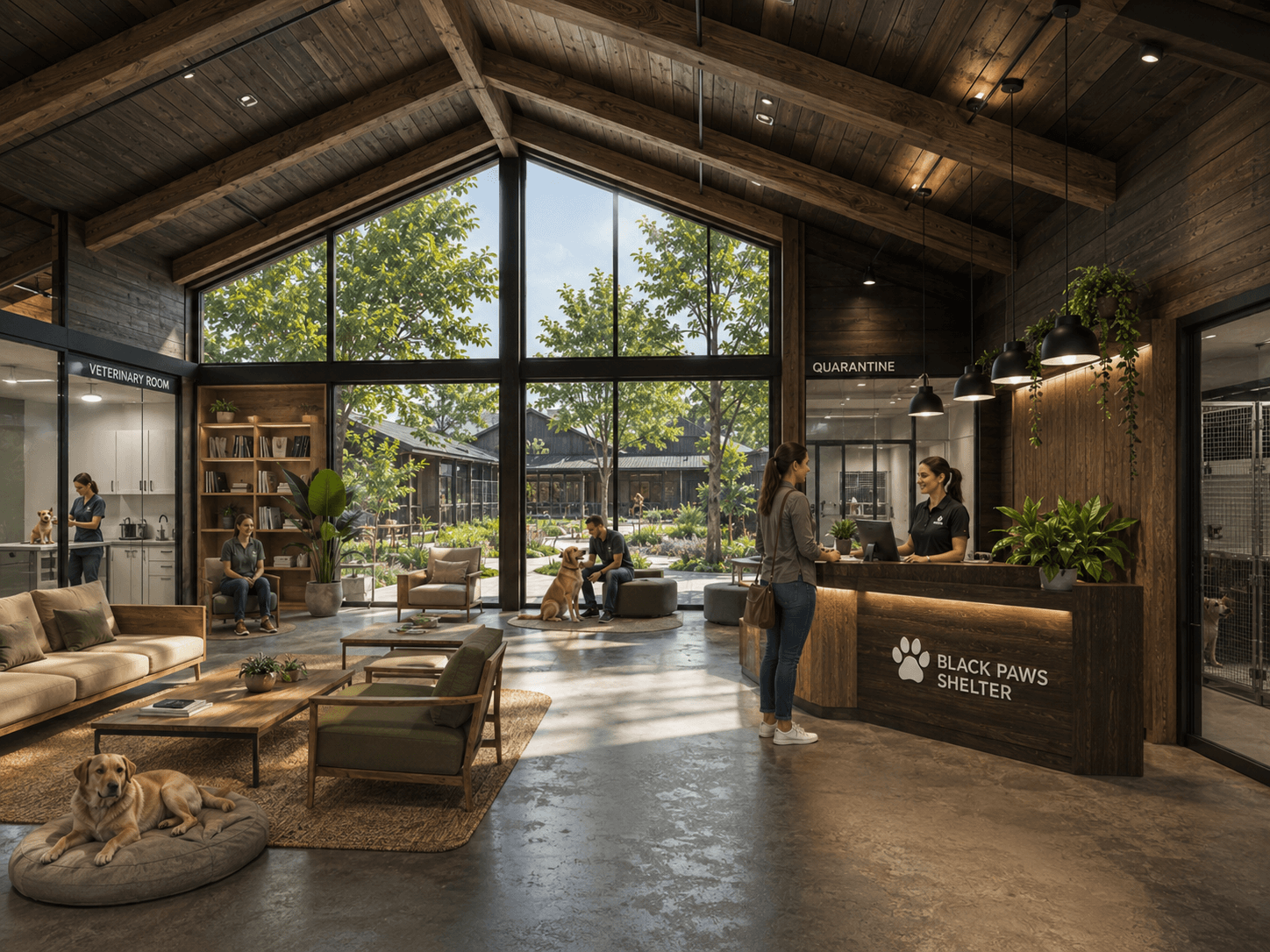
This means that routine, team training, enrichment, and daily management must all be designed as part of the same philosophy. A low stress shelter does not work only through walls, fences, and beautiful renderings. It works through what happens every day: how the dog is treated, how predictable the environment is, how much pressure they feel, how much movement they get, how much quiet they receive, and how well they are observed. Design is the foundation. But daily operation makes the real difference. And when routine, handling, enrichment, and observation are built correctly, the shelter becomes more than a transit space. It becomes a place that reduces suffering and increases real chances for recovery and adoption.
Share this article: